
Mould in the Home: Why Finding the Moisture Source Matters
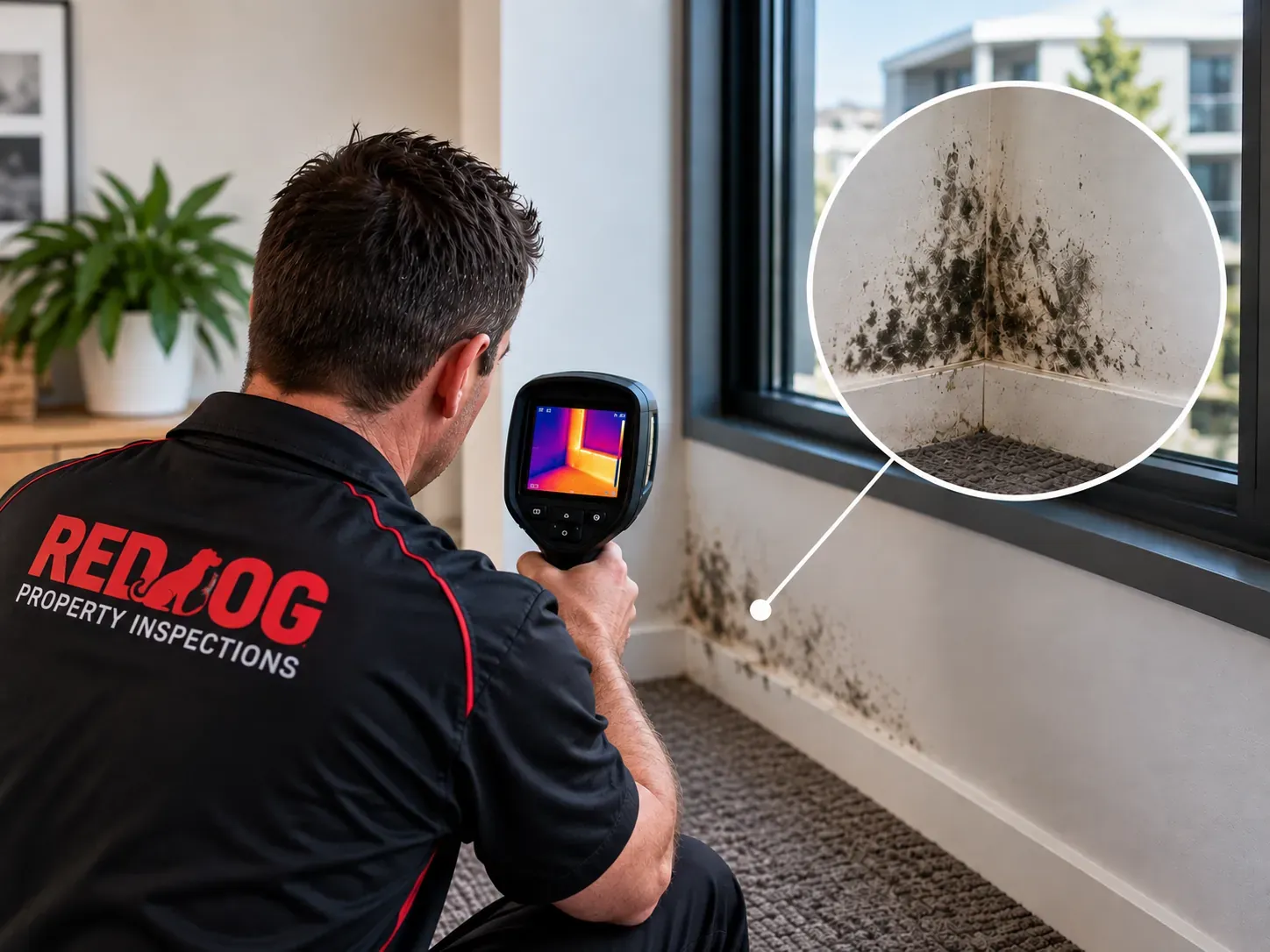
Mould is one of the more concerning issues homeowners, tenants and property managers can discover in a property. While the visible growth often receives most of the attention, mould is usually a symptom of a moisture problem rather than the underlying problem itself.
A recent Red Dog Property Inspections Moisture, Dampness & Indoor Environmental Assessment provides a good example of why investigating the building as a whole is important. The assessment identified visible microbial growth together with saturated building materials, water ingress, elevated indoor humidity, condensation, external water-management concerns and ineffective bathroom ventilation.
What Causes Mould to Develop?
Mould requires suitable environmental conditions to grow, with moisture being one of the most important factors. Moisture within a building can originate from many different sources, including rainwater ingress, plumbing leaks, failed waterproofing, condensation, poor drainage, elevated indoor humidity and inadequate ventilation.
This means simply cleaning or painting over visible mould may not resolve the problem. If the moisture source remains, conditions conducive to microbial growth can continue and the mould may return.
In the property assessed by Red Dog, visible microbial growth was concentrated around lower external walls, beneath lifted carpet and underlay, and around window and floor junctions. Importantly, these areas corresponded with locations where moisture testing identified saturated building materials and evidence of moisture intrusion.
Water Ingress Can Be More Complex Than It Appears
Finding water inside a building does not necessarily mean the point where the water appears is where it entered.
Water can migrate through wall systems, building cavities, window interfaces and adjoining construction before becoming visible internally. This is particularly important in apartments and other complex buildings where façades, roofs, balconies, windows and waterproofing systems may interact.
In this assessment, deteriorated or potentially vulnerable façade joints and cladding interfaces were identified externally. Significant ponding water was also present on an adjoining roof/deck area following rainfall. Internally, saturated materials and deterioration were identified in corresponding areas. The evidence was consistent with possible rainwater penetration, although the precise entry pathway could not be confirmed through a non-invasive inspection alone.
This is why a moisture assessment should avoid jumping immediately to a conclusion. Sometimes controlled water testing, leak detection or targeted invasive investigation is required before the source can be reliably established.
Humidity and Condensation Matter Too
Not every moisture problem originates from a leak.
High indoor humidity can create condensation when warm, moisture-laden air contacts cooler surfaces such as windows and external walls. Persistent condensation can wet moisture-sensitive materials and contribute to conditions suitable for microbial growth.
During this particular assessment, indoor relative humidity readings of approximately 83–86% RH were recorded across several areas of the apartment. Condensation was also observed on bedroom glazing and around the window perimeter. The report recommended maintaining indoor relative humidity below 60% where practicable, with approximately 40–60% providing a practical target range for occupied residential environments.
These readings are useful evidence, but they need to be interpreted alongside weather conditions, occupancy, ventilation and the moisture condition of the building.
Ventilation Can Contribute to the Problem
Bathrooms, laundries and kitchens generate significant amounts of moisture. Effective ventilation helps remove moisture-laden air before it contributes to prolonged high humidity and condensation.
During the assessment, the bathroom exhaust system did not demonstrate effective air movement at the intake sufficient to provide confidence that moisture-laden air was being adequately extracted. Reduced ventilation was considered a potential contributor to the elevated humidity and condensation conditions. However, importantly, it did not adequately explain the localised saturated materials and external water-management issues found elsewhere in the property.
That distinction matters. A building can have more than one moisture mechanism operating at the same time.
Moisture Testing Helps Build the Picture
A professional moisture assessment may use several non-invasive tools alongside visual inspection.
Electronic moisture meters can help identify abnormal moisture patterns within accessible materials. Infrared thermal imaging can identify apparent surface-temperature differences that may warrant further investigation, while temperature and relative-humidity measurements provide information about the indoor environment.
These instruments do not provide all the answers on their own. For example, an elevated moisture reading confirms an abnormal condition but does not automatically establish where the water came from or how long it has been present.
The readings need to be considered together with staining, deterioration, moisture distribution, building construction, external conditions and other available evidence.
Treat the Moisture Source Before the Mould
One of the most important principles when dealing with mould is that moisture-source control comes first.
Where building materials have become saturated, simply cleaning visible mould and reinstalling finishes may conceal an unresolved problem. The source of moisture should first be investigated and rectified. Affected materials can then be assessed to determine whether they can be satisfactorily dried and restored or require removal.
In the property assessed, the recommendations included further investigation of the building envelope, rectification of the moisture source, structural drying by a Water Damage Restoration Contractor and remediation of visible microbial growth by a Certified Microbial Remediation Technician.
Depending on the extent and circumstances, independent post-remediation verification by an appropriately qualified environmental professional may also be appropriate.
Can You Tell What Type of Mould It Is by Looking at It?
No.
The colour and appearance of mould should not be relied upon to determine its genus or species. Terms such as black, green or white mould describe appearance only.
Where identification or environmental sampling is required, appropriate sampling and laboratory analysis need to be separately undertaken. A building moisture assessment is primarily concerned with identifying why conditions suitable for microbial growth are occurring and what needs to be investigated or rectified.
Prevention Starts With Moisture Management
Homeowners can reduce the likelihood of mould by paying attention to the moisture performance of their property.
Effective bathroom and kitchen ventilation, controlling indoor humidity, maintaining roofs and gutters, addressing plumbing leaks promptly, monitoring windows for persistent condensation and investigating unexplained staining or dampness can all help.
Portable dehumidifiers and air-conditioning dry modes can assist with humidity management in some circumstances, but they should not be treated as substitutes for repairing water ingress, plumbing leaks, waterproofing defects or other building-related moisture sources.
When Should You Investigate?
Persistent musty odours, recurring mould, bubbling or deteriorating paint, stained plasterboard, damp carpet, condensation, swollen skirtings or cabinetry and unexplained moisture around windows are all signs that further investigation may be worthwhile.
The earlier the moisture mechanism is identified, the better the opportunity to address it before deterioration becomes more extensive.
At Red Dog Property Inspections, our Moisture, Dampness & Indoor Environmental Assessments look beyond the visible mould. We assess accessible building conditions, moisture patterns and indoor environmental factors to help identify potential moisture sources and provide practical recommendations for further investigation, drying, repair and remediation.
Helping you understand what’s happening inside your property, not just what you can see.

Ready to book your inspection?
Get a fast, clear report from Registered Building Practitioners with 35+ years' experience.