
Front Door Maintenance
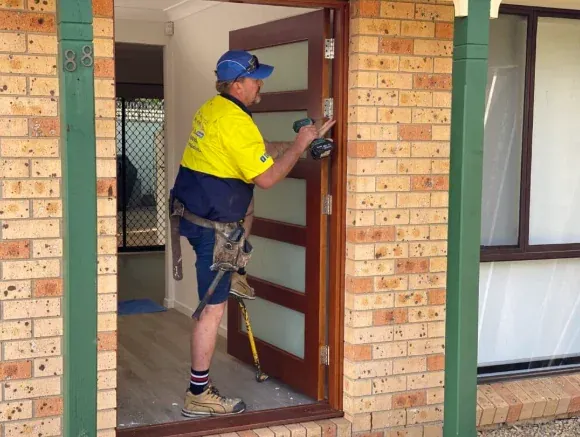
The front door is the gateway to our homes. It provides access for the occupants and your guests and more importantly, an entry door provides security for your family and personal items.
Entry doors do require ongoing maintenance due to continuous use and exposure to weather conditions. Constantly changing temperatures that differ from one side of the door to the other, UV exposure, salt spray and rising and falling humidity are some of the conditions that an entry door can be exposed to.
Excessive rain can also wear timber out if it has not been protected adequately whilst moisture in dark damp areas can encourage rotting and mould to grow.
Here are some common problems with front doors, and how to solve them.
Binding or Jamming
Binding and/or jamming of a door inhibits the functionality of the affected door as well as creates the potential for secondary defects to associated building elements, such as damage to the floor covering.
A door that binds to flooring or the associated door frame may have several causes, ranging from minor defects, such as poor installation of the door or deteriorated hinges, to major structural issues, such as damage to subfloor structures. Where door binding/jamming appears to indicate major structural issues, a registered builder should be appointed to provide an estimate on the cost of rectification. For minor cases, a qualified carpenter should be appointed to perform minor rectification works at the client’s discretion.
Twisting or Warping
Another common problem with front doors (most prevalent with solid timber) is that they’ve gone out of shape. Solid timber is made from natural fibres that expand and contrast when the weather changes, so when moisture, temperature and air pressure are high the door will experience a slight change in shape.
These slight changes can add up to a massive change—making the entire door catch against the edges of the frame. To solve this problem, identify the edges that are catching and sand or cut them down to a straight edge.
Replacement of the affected door may also be required to assist in maintaining a weather-tight seal. A qualified carpenter or door manufacturer should be engaged for further advice.
Door Handle or Lock Not Working
Many doors handle and lock problems can be corrected before they become so serious that the lock does not work at all. Often, a malfunctioning latch assembly or lock mechanism causes the problem.
The lock mechanism may not work simply because the lock is dirty or dry and needs to be lubricated with graphite (do not use any type of oil because this will gum up the works). An improperly functioning latch plate may be the result of a poorly fitting door.
When a door latch does not click into position, it usually means the latch and the strike plate are out of alignment. Tighten the hinge screws and then try adjusting the strike plate by loosening its screws and shifting it slightly. Repairs range from making minor latch adjustments to repositioning the door.
If the latch does not catch, close the door slowly to watch how the latch bolt meets the strike plate. The bolt may be positioned above, below, or to one side of the strike plate.
For serious lock problems, it is usually best to call a locksmith or replace the lock entirely. Most interior door handles and locks are relatively inexpensive to replace.

Ready to book your inspection?
Get a fast, clear report from Registered Building Practitioners with 35+ years' experience.